


After three interest rate cuts from the Reserve Bank this year, mortgage holders are finally getting some relief.
According to the latest data from the Australian Prudential Regulation Authority (APRA), the share of home loans that were overdue by 30 to 89 days fell to 0.55% in the June quarter. Serious arrears, or loans overdue by at least 90 days, also edged lower.
“The drop in arrears [in the June] quarter might be minor, down from 0.60% to 0.55% as a share of all lending, but behind these figures are households trying to keep the roof over their heads,” says Sally Tindall, Data Insights Director at financial comparison site Canstar.
“Rate cuts are giving some households just enough breathing room to get back on top of their repayments,” she adds.
Figure 1: Key statistics for authorised deposit-taking institutions’ (ADIs’) residential lending exposure

Source: APRA, Quarterly authorised deposit-taking institution property exposure statistics
Likewise, a recent Roy Morgan report found that the proportion of borrowers at “extreme risk” of mortgage stress went down from 19.7% in June 2024 to 18.5% in June 2025. Mortgage holders are considered at extreme risk if their interest-only repayments take up a large share of their household incomes.
However, most of the relief was felt by higher-income households, or those earning $100,000 or more a year. Among the lowest 40% of earners, mortgage stress actually rose, with a 5% increase in those classified as extremely at risk.
“Sluggish income growth was a major contributing factor, compounded by declining employment,” says Roy Morgan CEO Michele Levine.
Lending hits a record high
In a sign of renewed market activity, APRA data shows that the total value of new loans rose by $33 billion in the June quarter, a 21.3% increase from the previous period and the highest figure on record.
“New lending has gone through the roof, with more than $187 billion in mortgages funded in just three months,” says Tindall. “Buyers are clearly back in force, spurred on by lower rates.”
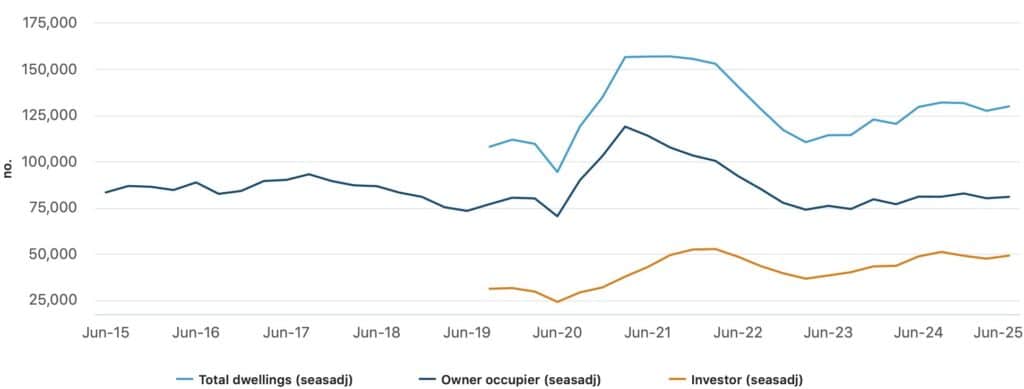
According to the Australian Bureau of Statistics (ABS), investment loans drove the growth. The number of new investment loans increased by 3.5% to 49,065, while new owner-occupier loans rose by 0.9% to 80,929.
Figure 2: Number of new housing loan commitments, June 2025*
Source: Australian Bureau of Statistics
* Seasonally adjusted (‘seasadj’)
“The 3.5% quarterly growth in the number of investment loans follows two consecutive quarterly falls,” says ABS Head of Finance Statistics Mish Tan. “While annual growth slowed to 0.8% from 27.0% in the June quarter 2024, the number of new loans remained historically high.”
Offset savings decline
Not all the data was positive. The total amount sitting in mortgage offset accounts fell by $5.7 billion in the quarter to $301.9 billion. This 2% decline suggests many households dipped into their savings towards the end of the past financial year, according to Tindall.
“However, compared to a year ago, balances are still up, showing that plenty of people are getting ahead on their mortgages where they can.”
Broker share rises
In a win for brokers, APRA’s report also shows that borrowers are relying more on third-party distributors to secure loans. The share of new loans taken out through a third party, such as a broker, rose to 63.4% in the June quarter – up from 62.7% the previous six months.
“Brokers are continuing to win the tug-of-war for new customers, despite the fact that the big banks have been rolling out some of their sharpest rates to their direct-to-bank, online-only loans,” notes Tindall. “With almost two-thirds of new term loans now written through a third party, borrowers are clearly leaning on expert help to navigate the mortgage maze.”