

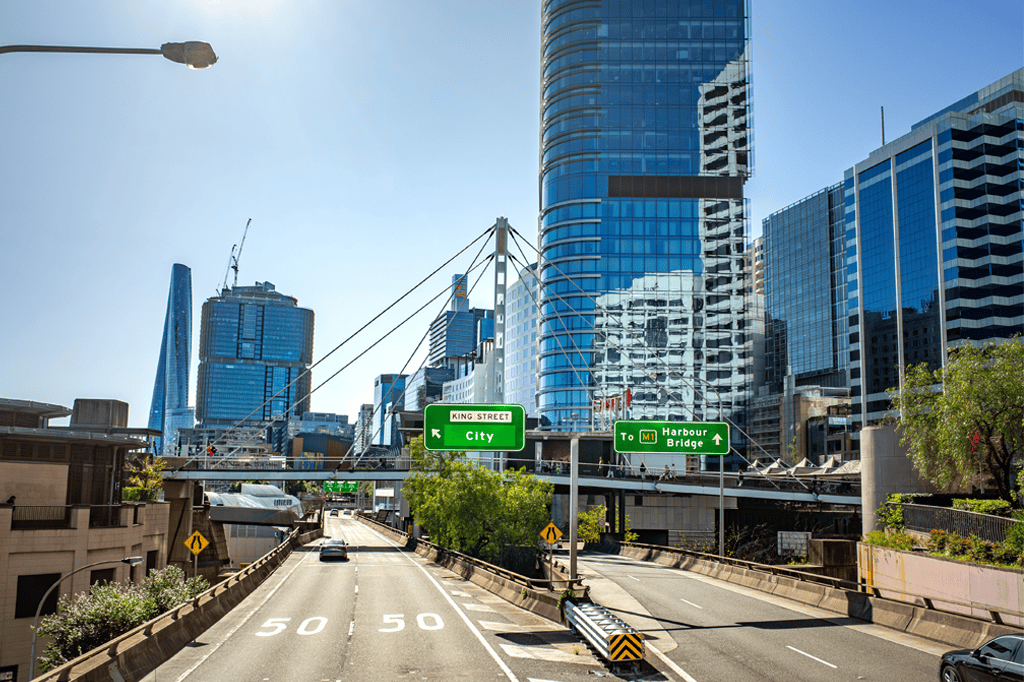
While the dominant themes of 2024 and 2025 revolved around inflation and interest rate adjustments, 2026 has ushered in a renewed focus on productivity and connectivity. Momentum is stirring, marking a transition from the policy-induced ‘gridlock’ of previous years toward a clearer ‘green light’ for investment.
The 2025–26 Federal Budget’s $17.1 billion allocation for road and rail infrastructure signals a fundamental realignment. Commercial property valuations are no longer solely dependent on historically valuable postcodes, but are increasingly determined by proximity to new multibillion-dollar transport arteries.
Yield compression and the ‘halo effect’
The link between major transport projects and property value has moved into a more active chapter. Data suggests a ‘halo effect’ where massive government spending effectively de-risks a precinct, giving private investors confidence even when the broader market is fluctuating. According to Knight Frank’s 2026 Horizon Report, this certainty is the main driver behind yield compression — the key lever currently easing the development squeeze. As yields tighten and asset values rise, the ‘economic rent’ needed to make new mid-market projects move forward becomes achievable.
In Sydney’s CBD office market, this process is already underway, with premium yields dropping by 25 basis points in the September quarter of 2025. While new projects remain improbable in the immediate term, the market is slowly changing as the gap between economic rents and forecast rents begins to close. Current projections suggest that the feasibility gap is set to close by 2028, signalling that new premium office towers are unlikely to reach completion before 2031.
Figure 1: Gap in Sydney CBD forecast to close by 2028.

Source: Knight Frank Research, 2026 Horizon Report, 3rd edition.
A similar pattern can also be seen in Melbourne’s prime industrial sector.
Investors are increasingly prioritising this ‘structural resilience,’ acknowledging that assets with superior connectivity act as a hedge against economic volatility. This infrastructure premium is reflected in the willingness of domestic REITs (real estate investment trusts) and institutions to return to the buyer’s circle, targeting locations where future rental growth prospects are supported by high-capacity transport infrastructure.
Western Sydney: the 30-minute city
The Sydney Metro Western Sydney Airport project is characterised by government leaders as a ‘game-changer’ for the region. As the project progresses, the focus has shifted from civil construction to the development of operational business hubs. This
momentum is supported by over $2.3 billion in critical infrastructure upgrades for Western Sydney, including a $1 billion commitment to preserve the South West Sydney Rail Extension corridor.
Commenting on the emerging growth corridors, REA Group senior economist Eleanor Creagh reflected that “generally, price growth and investor interest tend to concentrate where new employment, upgraded transport, and new home delivery with anticipated population growth are intersecting.”
This intersection is currently defining the Aerotropolis, where the Metro connection will enable the concentration of a highly skilled workforce, effectively turning the region into a ’30-minute city.’
The Olympic runway: Brisbane and the Gold Coast
Brisbane’s 2032 Olympic runway has kicked off a decade of urban renewal, fundamentally changing the market for the Brisbane fringe and the Gold Coast corridor. The Brisbane Organising Committee’s ’10+10+’ vision ensures that benefits are captured in the ten years leading up to the games and beyond. A defining feature of this cycle is the record $7.2 billion investment in safety and productivity upgrades for the Bruce Highway, the largest ever commitment to this nationally significant corridor.
This surge in funding is also turning specific areas into high-demand commercial hubs:
● Woolloongabba: Targeted as a Priority Development Area, evolving from a transport terminus into a genuine office fringe and health hub.
● Hamilton Northshore: A 304-hectare urban regeneration project accelerated by the Athlete’s Village, facilitating a shift toward innovation-focused mixed-use zones.
● The Gold Coast Pipeline: Benefiting from enhanced regional connectivity, satellite locations are seeing increased institutional interest as the ‘Olympic effect’ broadens the recovery.
Connectivity as a commodity
The early 2026 market indicates that the Australian commercial sector is reaching a turning point. While building from scratch still has its hurdles, the combination of tightening yields and infrastructure-driven tenant demand is creating a clear path forward. The government’s commitment to the Roads to Recovery Program also ensures that ‘last-mile’ logistics — the critical link between regional distribution hubs and the end-user — remains a priority.
Many investors are now moving away from a defensive stance and toward a more targeted approach, focusing on assets that offer long-term demand within major transport hubs. As these infrastructure projects come online, the gap between ‘connected’ precincts and isolated assets will be the biggest driver of commercial value for years to come.


